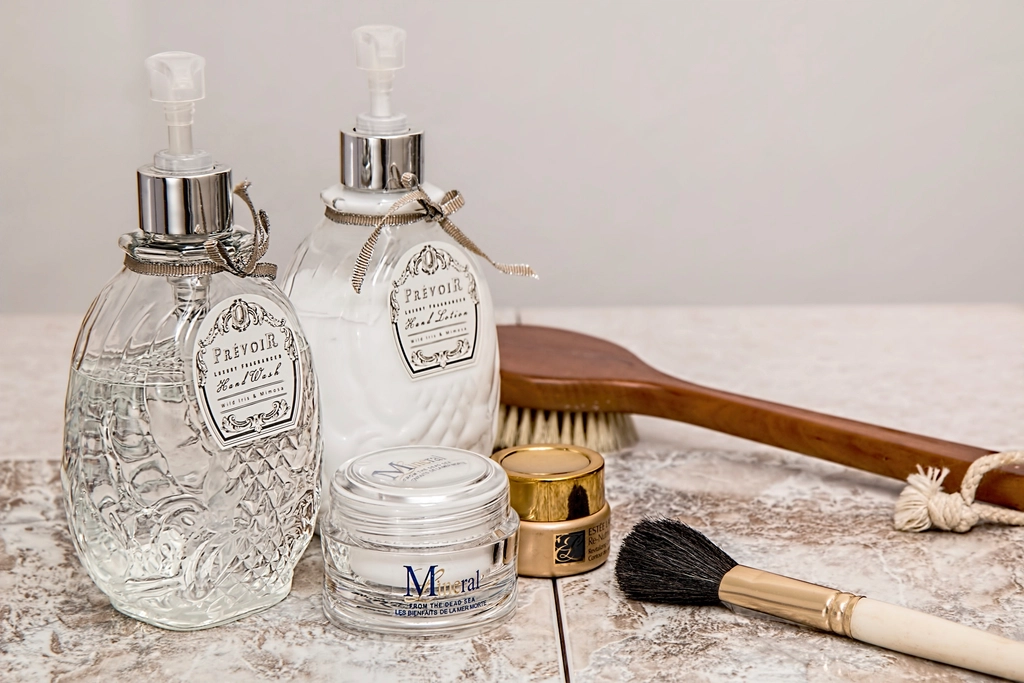
“Clean.” “Natural.” “Non-toxic.” These words appear on packaging with no legal definition behind them — which means they tell you almost nothing. Neither the U.S. Food and Drug Administration nor the European Union defines “clean” in cosmetic law; the closest either comes is regulating what must appear on the ingredient list itself, not what marketing language can claim around it.
What actually matters is whether a brand shows its work: what’s in the formula, what each ingredient does, and whether there’s evidence behind the claims. Here’s how to read a label for yourself — in about five seconds at the shelf.
Key takeaways
- The ingredient list is regulated in both the U.S. and the EU; the front of the bottle isn’t
- The first five ingredients do most of the work, since anything above 1% concentration must appear in descending order
- “Clean” has no legal definition — specificity is the real trust signal
- Look up unfamiliar names free at EWG’s Skin Deep database
- Bakuchiol, bio-fermented squalane, and pre/postbiotic formulas now have real clinical and academic research behind them — not just marketing copy
1. Skip the front of the bottle entirely
The marketing copy on the front is unregulated in a way the ingredient list is not. In the United States, the FDA’s own Cosmetics Labeling Guide requires that the full ingredient declaration be accurate and listed “in descending order of predominance,” with one carve-out: ingredients present at a concentration below 1% may then appear in any order. In the European Union, Regulation (EC) No 1223/2009 imposes the identical rule — Article 19 requires the ingredient list to be “established in descending order of weight,” with the same sub-1% exception. That single rule, mirrored on both sides of the Atlantic, is your superpower.
Neither regulation defines “clean,” “natural,” or “non-toxic.” The EU regulation’s only labeling requirements concern the responsible party’s name and address, product content, durability date, precautions, batch number, and the ingredient list — nothing about front-of-pack marketing language. That’s a legal gap, not an oversight; it’s simply outside what either regulator considers its job.
2. Read the first five ingredients — they are the product
The first five or six names are doing most of the work. Everything listed after “fragrance” or a preservative is usually present in trace amounts — including that exotic botanical the front of the box is named after. This isn’t a guess: both the FDA and EU Regulation 1223/2009 require descending-order listing specifically so that position on the list reflects concentration.
A free habit worth building: look up unfamiliar ingredient names in EWG’s Skin Deep database before you buy. The database is reviewed by EWG’s team of toxicologists, chemists, and epidemiologists against the organization’s own transparency and health standards. It won’t declare a product “good” or “bad” — it shows what’s actually known about an ingredient’s safety profile so you can draw your own conclusion.
3. Know what “science-led” actually looks like
The credible shift in skincare isn’t a new buzzword — it’s brands replacing “free-from” claims with specifics, and increasingly, with published research behind individual ingredients. Three ingredient categories you’ll see more of:
- Bio-fermented actives (like lab-cultivated squalane) — more traceable, less resource-intensive than plant- or animal-derived versions. Squalane traditionally came from shark liver oil; a peer-reviewed review in Engineering in Life Sciences on microbial squalene production describes how engineered yeast strains can now produce it via fermentation at industrial scale, offering a renewable, traceable alternative. Squalene itself is a well-studied skin lipid: a review in the journal Molecules, indexed on PMC, documents its role as one of the main components of skin surface lipids and its function as an emollient and antioxidant.
- Bakuchiol — a plant-derived retinol alternative with a real track record now, not just a marketing debut. A randomized, double-blind clinical trial published in the British Journal of Dermatology and indexed on PubMed compared bakuchiol directly against retinol over 12 weeks in 44 patients, finding both significantly reduced wrinkle surface area and hyperpigmentation with no statistical difference between them — while retinol users reported more scaling and stinging. The study’s own conclusion: bakuchiol is “a more tolerable alternative to retinol.”
- Pre- and postbiotic formulas — built around supporting the skin’s microbiome rather than stripping it. A 2025 review on postbiotics and skin health describes how the skin microbiome plays a role in barrier function and immune defense, and how postbiotics — non-viable microbial cells or their metabolites — can offer anti-inflammatory effects, support hydration, and strengthen the skin barrier without the safety concerns associated with live bacteria. The same review notes that larger, long-term clinical studies are still needed to confirm effectiveness across different populations, which is a useful caveat for any brand claiming definitive microbiome results.
None of this means “natural” or “biotech” is automatically better. Specificity is the signal. A brand that explains exactly what an ingredient does — and can point to a study, not just a press release — is giving you more than one that just prints “clean.”
4. Run every label through these three questions
- Can I find out what the first five ingredients do? If the brand’s own site can’t explain them, that’s your answer.
- Is there a claim, or just a mood? “Reduces visible redness in 4 weeks in a 40-person trial” is a claim. “Clean, glowing, radiant” is a mood.
- Would this brand survive an independent look-up? Cross-check anything surprising against EWG rather than the brand’s claims page.
You don’t need to memorize organic chemistry to shop well. You need a habit: read the list, look up anything unfamiliar once, and treat specificity — not the word “clean” — as the marker of trust.
FAQ: skincare labels
Is “clean beauty” regulated?
No. “Clean,” “natural,” and “non-toxic” have no legal definition in the EU or US. Only the ingredient list itself is regulated — under the FDA’s cosmetics labeling rules in the U.S. and Regulation (EC) No 1223/2009 in the EU — which is why reading it beats trusting a badge.
What order are ingredients listed in?
Descending order of concentration, until ingredients drop below roughly 1% — after that point they may appear in any order. Both the FDA and the EU Cosmetic Products Regulation use this exact threshold. That’s why position on the list matters more than presence.
Does “fragrance” on a label mean one ingredient?
No — “fragrance” (or “parfum” in the EU) can legally bundle many undisclosed compounds under one word. The FDA permits fragrance and flavor compounds to be declared simply as “fragrance” in descending order of predominance, and even masking agents added to cover an unwanted odor can be folded into that same word. EU Regulation 1223/2009 takes the same approach, requiring perfume compositions to be listed as “parfum” or “aroma” rather than broken into individual components. If your skin is reactive, it’s the first thing to screen for.
Is bakuchiol actually comparable to retinol?
The best current evidence says yes, with better tolerability. The 12-week, 44-patient randomized trial published in the British Journal of Dermatology and available via PubMed found bakuchiol produced comparable improvements in wrinkles and hyperpigmentation to retinol, with fewer reports of scaling and stinging. It’s one small study, not a settled scientific consensus, so treat it as a strong data point rather than the final word.
Keep reading The Ritual: The 9 Best French Pharmacy Skincare Products of 2026 — label-reading applied to an entire shopping trip · The Capsule Vanity. For the full edit every Sunday, subscribe to The Gilt Letter.
Sources & Data
- U.S. FDA, “Cosmetics Labeling Guide” — fda.gov/cosmetics/cosmetics-labeling-regulations/cosmetics-labeling-guide (primary)
- European Union, “Regulation (EC) No 1223/2009 on Cosmetic Products” — eur-lex.europa.eu/legal-content/EN/TXT/?uri=CELEX:32009R1223 (primary)
- Environmental Working Group, “Skin Deep Cosmetics Database” — ewg.org/skindeep (primary)
- Dhaliwal et al., “Prospective, randomized, double-blind assessment of topical bakuchiol and retinol for facial photoageing,” British Journal of Dermatology (2019), via PubMed — pubmed.ncbi.nlm.nih.gov/29947134 (secondary)
- Huang, Lin & Fang, “Biological and Pharmacological Activities of Squalene and Related Compounds,” Molecules, via PMC/NIH — pmc.ncbi.nlm.nih.gov/articles/PMC6253993 (secondary)
- “Microbial Squalene: A Sustainable Alternative for the Cosmetic Industry,” Engineering in Life Sciences, via PMC/NIH — pmc.ncbi.nlm.nih.gov/articles/PMC11464149 (secondary)
- Prajapati et al., “Microbiome and Postbiotics in Skin Health,” Biomedicines, via PMC/NIH — pmc.ncbi.nlm.nih.gov/articles/PMC12025169 (secondary)
Leave a Reply