Everyone has met the capsule wardrobe. Almost nobody applies the same editing eye to the dressing table — the first surface you face in the morning and the last one at night.
Most vanities are archaeology: half-finished serums, a hotel sewing kit, three nearly identical lip balms. The quiet-luxury answer is not more beautiful clutter. It is seven things that work, and a surface that breathes.
The capsule vanity test
Every object below passes the same three checks:
- Used daily or weekly — not “someday”
- Kept for years — buy once, buy right
- Better than the five things it replaced
1. A tray — the €12 object that does the most work
The single highest-leverage item on this list. Ceramic, lacquer, travertine — whatever pleases you.
A tray turns a scatter of products into a still life. More usefully, it enforces the edit: what fits on the tray stays; what doesn’t goes in the drawer or the bin. The tray is the budget.
2. A silk pillowcase
Technically bedroom, spiritually vanity. Less friction means less overnight creasing of skin and less breakage at the hairline — modest, real, cumulative benefits, and increasingly ones you don’t have to take on faith. Independent laboratory testing comparing a 22-momme mulberry silk pillowcase against standard cotton found silk produced 34% less hair-damaging friction than cotton, with cotton generating 51% more friction than silk across dozens of measured passes on multiethnic hair samples. Less friction on the hair shaft overnight is the same mechanical logic dermatologists cite when they recommend gentler fabrics to reduce mechanical stress that leads to split ends and breakage.
The skin argument runs on the same logic: a coarser weave drags and creases the face for the seven or eight hours it’s pressed against it each night, while a smoother fiber lets skin glide rather than fold. It won’t undo a night of poor sleep, but cumulative micro-friction, repeated for years, is exactly the kind of “small and constant” input the capsule philosophy is built to fix.
It also explains why the pillowcase earns a place on this list rather than, say, a fourth serum. Nothing here claims to erase a wrinkle overnight. The claim is narrower and more honest: reduce a small mechanical stressor that repeats roughly 2,500 times a year, and the accumulated difference over a decade is not nothing. That is the entire quiet-luxury argument in miniature — not a miracle object, a slightly better default, chosen once and then simply left alone to do its unglamorous work.
- What to look for: mulberry silk, 19 momme or higher — momme is the industry’s actual weight-and-density measure for silk, comparable to thread count in cotton, and textile guidance defines anything under 20 momme as lightweight, 20–28 as midweight, and above 28 as heavy, with higher momme generally meaning denser, more durable silk
- Colour rule: one you would wear
- Care: wash it like the investment it is
3. One magnifying mirror with honest light
Not the ring-light kind that flatters you into false confidence — a simple 5x mirror near a window or under neutral LED. Daylight and neutral LEDs render color and texture close to how they’ll actually appear under office lighting or an afternoon coffee; warm bathroom bulbs and flattering ring lights do the opposite, smoothing texture and warming tone until the face in the mirror bears only a passing resemblance to the face other people see.
Ten seconds of honest light every morning replaces an entire shelf of corrective products bought in panic under bad bathroom bulbs.
4. Tweezers that will outlive you
The classic slant-tip Tweezerman remains the reference: aligned tips, real tension, and — unusually for a €20 object — a genuine free lifetime sharpening service that the brand confirms covers full-size and mini slant tweezers, point tweezers, scissors and nippers for as long as the implement can be re-sharpened, with the customer paying only outbound shipping.
It is the cheapest item in the buy-once category — and the one you will notice every week for the next twenty years. Most drugstore tweezers lose their alignment within a year and get quietly replaced, which is its own small tax on the vanity: another packet in the drawer, another five euros gone, another decision deferred rather than made. A tool with a documented sharpening pathway removes that decision permanently. You are not buying tweezers; you are buying an end to buying tweezers.
5. A hand cream that lives in sight
Hands age in public while faces get all the budget. Keep one excellent hand cream on the tray, not in a drawer — visibility is compliance.
The French pharmacy shelf does this brilliantly and cheaply; a lanolin-rich classic used nightly beats a luxury jar used monthly. Lanolin is not a folk remedy dressed up as skincare — cosmetic-science literature documents that topically applied lanolin measurably accelerates skin barrier recovery and significantly reduces transepidermal water loss, with hydrating effects that can still be detected up to fourteen days after treatment stops, which is precisely why one modest lanolin cream, used consistently, outperforms a rotating cast of prettier ones. (Our full guide: French pharmacy skincare — what to actually buy.)
6. A linen or waffle robe
The object that changes the temperature of the whole ritual. Washed linen in summer, waffle cotton in winter.
A proper robe converts ten rushed minutes at the mirror into something closer to ceremony — the difference between getting ready and attending to yourself.
7. A candle you actually burn
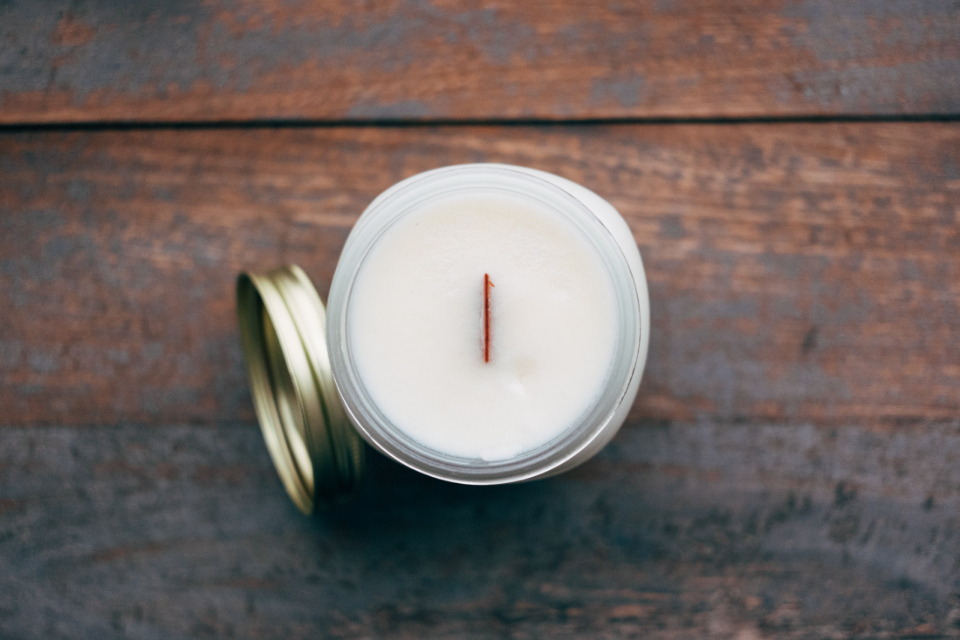
Not the display candle with the dusty wick. One honest candle, lit during the evening routine, retrains the ritual as a signal: the day is ending, the phone can wait.
Burn it. Finish it. Replace it.
The vanity is a small room of one’s own. Keep it edited like one.
The 10-minute vanity edit (do it tonight)
- Clear everything off the surface. Everything.
- Bin anything expired, separated, or that smells “off” — mascara over 3 months, SPF over a year. These are not arbitrary numbers: the FDA notes that industry experts recommend replacing mascara three months after purchase, because repeated exposure to bacteria and fungi during daily use makes eye-area products the shortest-lived items on any vanity. Sunscreen runs on a separate, federally regulated clock: the FDA requires that any sunscreen without a printed expiration date be treated as expired three years after purchase, and dermatologists commonly advise budgeting for a fresh bottle every season it’s opened and exposed to heat and light — which is where the practical “one year” rule of thumb for an open, well-used bottle comes from.
- Drawer anything used less than weekly.
- Return only what fits the tray. If you don’t own a tray yet, a plate works tonight.
FAQ
What is a capsule vanity?
A capsule vanity applies the capsule-wardrobe principle to your dressing table: a small, edited set of beauty essentials you use constantly and keep for years, instead of a rotating collection of impulse buys.
How many products should be on a minimalist vanity?
Whatever fits on one tray — for most women that’s five to nine objects. The number matters less than the rule: the tray is the budget.
Isn’t quiet luxury just expensive minimalism?
Half the items here cost under €20. Quiet luxury is an editing philosophy — fewer, better, used daily — not a price point. It borrows its logic more from behavioral economics than from any particular price tag: fewer decision points at the mirror each morning, fewer products competing for the same ten minutes, and a tray that makes the edit visible rather than aspirational.
Is there real evidence behind a silk pillowcase, or is it just a marketing claim?
There is genuine mechanical evidence, though it’s worth reading with the right expectations. Independent lab testing has quantified the friction difference between silk and cotton directly — a 34% reduction in hair-damaging friction for a 22-momme mulberry silk pillowcase compared with cotton — which supports the long-standing dermatological logic that smoother, lower-friction surfaces cause less mechanical stress to hair and skin overnight. As with most beauty claims, the honest framing is “meaningfully reduces a real mechanical stressor,” not “reverses aging.”
The Gilt Letter delivers one essay, one ritual and three finds like these every Sunday. Join the founding readers here — and if the vanity edit felt good, your Sunday evenings are next: the one-hour Sunday reset.
Sources & Data
- FDA, “Cosmetics Safety Q&A: Shelf Life” — mascara replacement guidance (primary): https://www.fda.gov/cosmetics/resources-consumers-cosmetics/cosmetics-safety-qa-shelf-life
- FDA, “Sunscreen: How to Help Protect Your Skin from the Sun” — SPF expiration requirements (primary): https://www.fda.gov/drugs/understanding-over-counter-medicines/sunscreen-how-help-protect-your-skin-sun
- Mulberry Park Silks / independent textile lab testing, “Silk vs. Cotton Study” — friction reduction data (secondary, brand-commissioned independent lab test): https://mulberryparksilks.com/blogs/mulberry/silk-pillowcases-lab-tested
- Mulberry Park Silks, “What is Momme in Silk Fabric?” — momme as a silk-quality standard (secondary): https://mulberryparksilks.com/blogs/mulberry/what-is-momme-in-silk-fabric
- Tweezerman, official Guarantee page — free lifetime sharpening service terms (primary): https://www.tweezerman.com/pages/guarantee
- Society of Cosmetic Chemists, “Volume 55 No 2” journal — lanolin barrier recovery and transepidermal water loss research (primary, peer-reviewed cosmetic science): https://library.scconline.org/v055n02/56
Leave a Reply